
On 7 January 2025, the Construction Products Regulation officially entered into force.
One of the most anticipated new features of this regulation is the Digital Product Passport (DPP) for construction products.
Much of the framework, however, has yet to be defined: many points will be settled along the way, through delegated acts and new harmonised standards rolled out over time.
In this article, we review what the CPR provides for, how the digital product passport generally works within this framework, and the timeline for the next steps.
Article summary
- The revised CPR (EU Regulation 2024/3110) entered into force in early 2025 and introduces, among other things, a mandatory digital passport for construction products, in a drive towards a single market, sustainability and digitalisation.
- The European DPP registry has been live since July 2026, but it is not yet open to construction products. The registry does not store data: it only references the passports, which remain hosted by manufacturers or their service providers.
- For construction, the exact content and timeline are still to be defined: the obligation will not arrive on a single date but product family by product family, as new harmonised standards are adopted, starting in 2026 for the first ones and mostly over 2028-2029.
What the Construction Products Regulation (CPR) provides for
Before focusing on the digital passport, let’s look back at the text that introduced it: the Construction Products Regulation (CPR).
What are the objectives of the CPR?
The central objective of the CPR is to ensure the free movement of safe and sustainable construction products within the single market.
The Commission started from a simple observation: the single market for construction products was not fully achieved, market surveillance varied widely from one Member State to another, and the legal framework had become too complex to support the green and digital transitions.
The revision therefore pursues three main goals, as presented by the European Commission:
- removing obstacles to the free movement of products within the European internal market;
- reducing the administrative burden, in particular through digital solutions;
- placing products within a circular economy approach and environmental sustainability, while strengthening safety.
What are the main measures of the CPR?
The new regulation translates into several major workstreams, detailed in the European Parliament’s legislative summary:
- Digitalisation and the digital passport. The CPR establishes a digital passport system for construction products. It will bring together the declaration of performance and conformity, the technical documentation and safety information, all accessible electronically and free of charge for consumers and authorities.
- Environmental sustainability. The regulation paves the way for minimum environmental performance requirements and uses public procurement (around 14% of EU GDP) as a lever to pull the market towards better-performing products. This is a key point for everything related to life cycle assessment (LCA) and environmental product declarations (EPDs).
- Stronger market surveillance. Better-equipped authorities, at least one contact point per territory, and a reporting portal for flagging suspected breaches.
Now let’s look at what the CPR provides for digital passports.
The CPR and the digital product passport
What is a digital product passport?
The digital product passport is a tool that makes a product’s information accessible via a QR code or an RFID tag. Depending on the product group, it may contain information on safety, origin, materials, repairability, environmental performance, reuse or recycling.
The general concept stems from the Ecodesign for Sustainable Products Regulation (ESPR), which covers consumer goods (fashion, furniture, etc.) and is being rolled out sector by sector.
For construction, however, the DPP has its own legal basis within the CPR: its details will be set by delegated acts specific to the sector.
In practice, the architecture relies on a European registry that has been live since July 2026. An important point: this registry does not store the product data itself. It provides the secure infrastructure to register unique identifiers and their metadata, while the passport data is kept in a decentralised way, that is, by brands or their service providers.
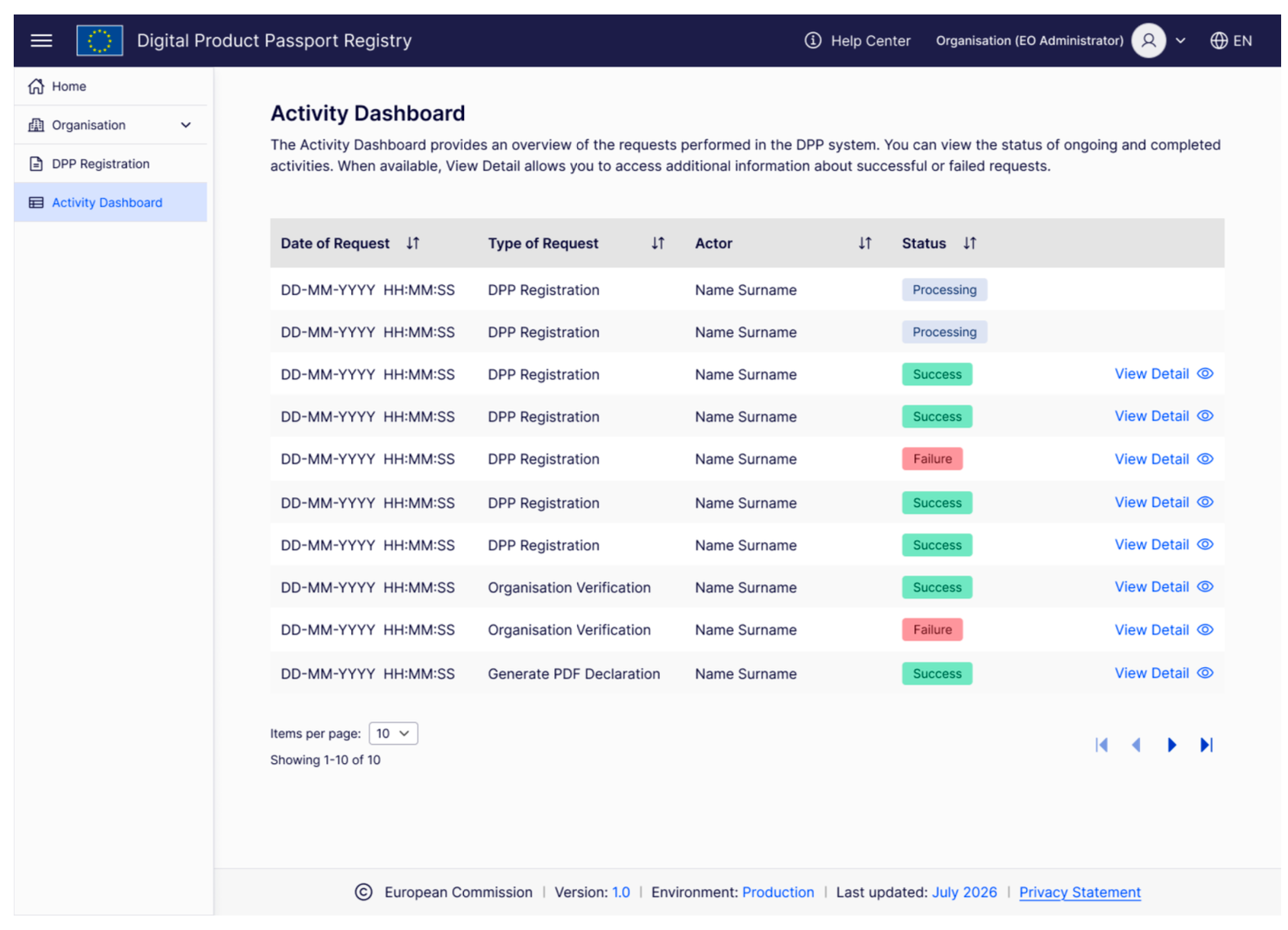
Screenshot of the digital product passport registry (provided by the EU).
What are the key dates for the rollout of digital product passports?
The rollout happens in waves, family by family.
Batteries are first in line: the European registry has been live since July 2026 and the deadline for these products is set for 18 February 2027.
For construction materials, the timeline was set out in the first CPR working plan 2026-2029, adopted by the Commission on 16 December 2025 (COM(2025) 772).
Key takeaways:
- A rollout paced by harmonised standards. Each product family will come into the scope of the DPP as its new harmonised standards and the associated delegated act are adopted. The plan stresses one point: all its dates are “indicative”.
- The first families concerned. The first standards made mandatory under the CPR cover concrete products (end of 2025, a deadline already missed), followed by structural metal products (Q2 2026). Details are available in the table below.
- The technical building block of the DPP is under construction. The Commission has launched the standardisation process to set the rules on data carriers, infrastructure and interoperability, which are essential for the passport system to work.
- A deadline rule to remember. Once the delegated act enters into force, manufacturers have 18 months to make the digital passport available via the construction DPP system (a deadline set by the regulation itself).
| Product family | Milestone I | Milestone III | Standardisation request | Standards delivery deadline | Standard made mandatory and DA adopted |
|---|---|---|---|---|---|
| precast normal/lightweight/autoclaved aerated concrete products | completed | completed | Q2 2025 | Q4 2025 | Q4 2025 |
| structural metallic products and ancillaries | completed | completed | Q3 2025 | Q4 2025 | Q2 2026 |
| doors, windows, shutters, gates and related building hardware | completed | completed | Q1 2026 | 2028 | 2029 |
| reinforcing and prestressing steel for concrete (and ancillaries) — post-tensioning kits | completed | Q4 2025 | Q2 2026 | 2029 | 2029 |
| cements, building limes and other hydraulic binders | completed | completed | Q3 2025 | Q3 2027 | Q4 2027 |
| thermal insulation products — composite insulating kits/systems | completed | In progress | Q3 2026 | 2029 | 2029 |
| flat glass, profiled glass and glass block products | completed | In progress | Q1 2026 | 2028 | 2029 |
| chimneys, flues and specific products | completed | In progress | Q3 2026 | 2028 | 2028 |
| structural timber products/elements and ancillaries | In progress | Q1 2026 | Q3 2026 | 2029 | 2029 |
| wood-based panels and elements | |||||
| products related to concrete, mortar and grout | In progress | Q1 2026 | Q4 2026 | 2029 | |
| masonry and related products, masonry units, mortars, ancillaries | In progress | Q2 2026 | Q1 2027 | ||
| aggregates | In progress | Q2 2026 | Q1 2027 | 2029 | |
| curtain walling/external wall cladding/structural sealant glazing | completed | Q2 2026 | Q4 2026 | 2029 | |
| fixed firefighting equipment (fire alarms, fire detectors, fixed firefighting equipment, fire and smoke control products, and explosion suppression products) | Q2 2026 | Q1 2027 | Q3 2027 | ||
| road construction products (asphalt, etc.) | Q1 2026 | Q3 2026 | 2027 | ||
| floorings | Q2 2026 | Q4 2026 | 2027 | ||
| prefabricated building kits, units and elements | Q2 2026 | Q2 2027 | 2027 | ||
| internal and external wall and ceiling finishes — internal partition kits | Q3 2026 | Q3 2027 | 2028 | ||
| gypsum products | Q3 2026 | Q3 2027 | 2028 | ||
| structural bearings, pins for structural joints | Q4 2026 | Q4 2027 | 2028 | ||
| space heating appliances and other heating and cooling appliances | Q4 2026 | Q4 2027 | 2028 | ||
| roof coverings, rooflights, roof windows and ancillary products, roofing kits, photovoltaic panels | 2027 | 2027 | 2028 | ||
| fixed circulation equipment: road equipment (paints, road signs, road restraint systems) | 2027 | 2027 | 2028 | ||
| wastewater engineering products | 2027 | 2028 | |||
| construction adhesives | 2027 | 2028 | 2029 | ||
| joint sealants | 2027 | 2028 | 2029 | ||
| fire protection products for structures, fire compartmentation, fire stopping and fire sealing — fire retardant products | 2028 | 2028 | 2029 | ||
| fixings | 2028 | 2028 | |||
| membranes, including liquid-applied kits (for waterproofing or vapour control) | 2028 | 2028 | |||
| geotextiles, geomembranes and related products | 2028 | 2028 | |||
| sanitary appliances | 2028 | 2029 | |||
| pipes, tanks and ancillaries not in contact with water intended for human consumption | 2028 | 2029 | |||
| construction products in contact with water intended for human consumption | |||||
| power, control and communication cables | 2029 | 2029 | |||
| decorative paints and wallpapers | 2029 | ||||
| chimneys, flues and specific products | 2029 |
In short, there is no “single date” for the DPP to come into force for construction: the obligation will arrive gradually, product family by product family, starting in 2026 for the first ones and mostly over 2028-2029, and the next working plan (expected by the end of 2028 at the latest) will refine this timeline further.
What will digital product passports contain?
This is currently the least clear point. The regulation sets out the main categories of information (declaration of performance and conformity, technical documentation, safety information), but the detailed data will be defined product by product.
As the Commission’s official FAQ on the DPP points out: for each product group, a dedicated delegated act will specify exactly what information the passport must contain. For construction, this will go through the CPR framework.
In summary: the direction is set and the infrastructure already exists, but the precise content of the passport for construction is still to be written. This is precisely the ideal time to start structuring your environmental data now, so you are ready the day the construction delegated act sets the rules of the game.